Is AI affecting Australian jobs?

Justin Strharsky
Head of Research, AITAI
Is AI affecting Australian jobs?
Whether and how much AI will affect jobs is top of mind around the world. Will change come gradually, giving workers and institutions time to adjust? Or fast, bringing displacement and disruption?
Our work found a small but significant signal: hiring in the occupations where AI is used is running about 5,500 advertisements a month below comparable occupations. That is roughly 24 missing for every 100 openings they posted in a typical month before ChatGPT, or about 2% of all job ads nationally.
A single finding, however, is a snapshot. To catch any change early, rather than explain it after the fact, we will monitor the place where change shows up first: job advertisements, the leading edge of the labour market. We call this the “canary in the coal mine” of AI’s impact on jobs, and we built an index to measure it on a regular basis. Here’s how it works:
The Canary Index:
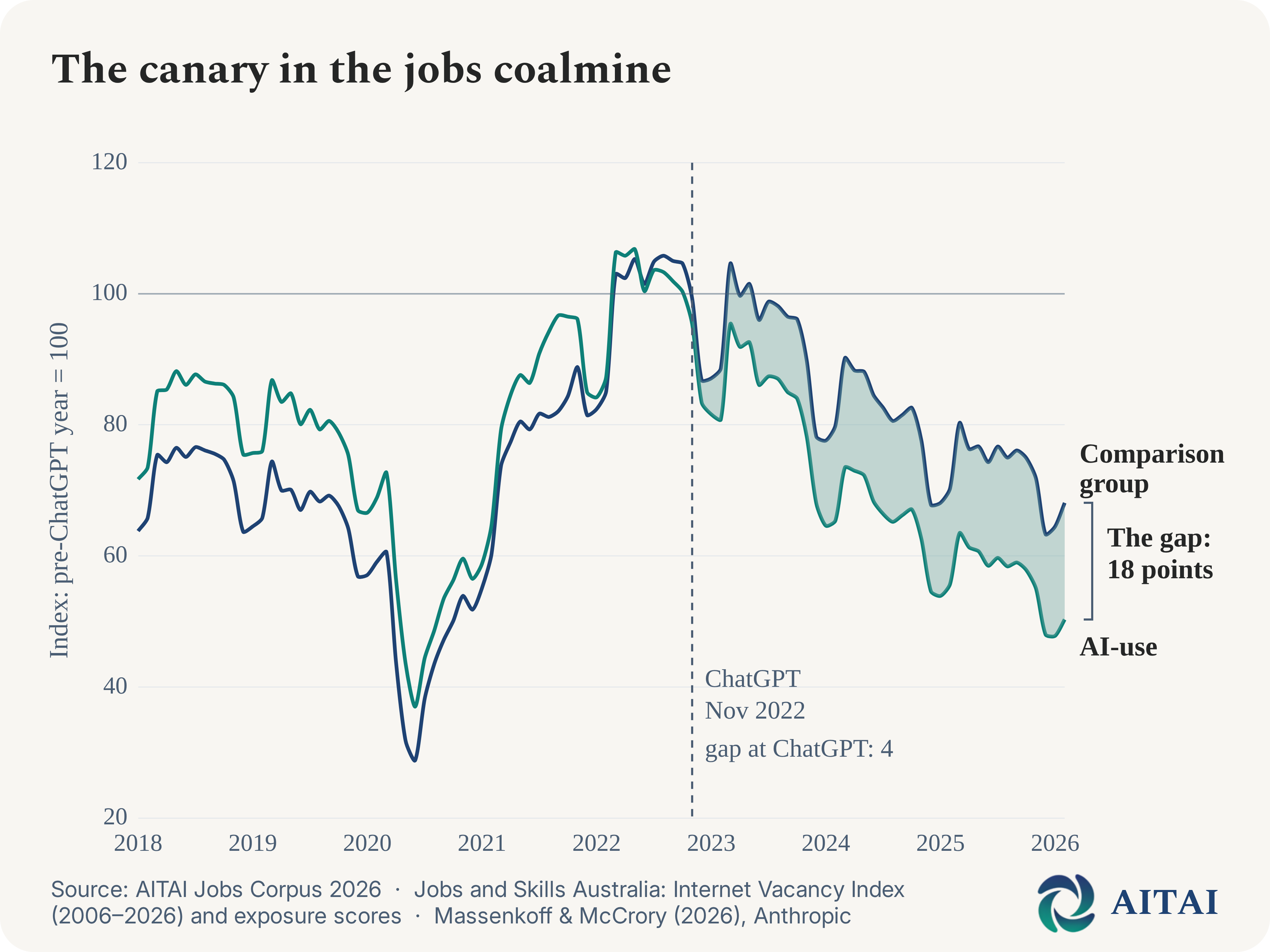
We track two groups of occupations. The first is the jobs where AI is actually being used, day to day: 14 occupations identified from real usage data, including software programmers, accountants, call centre workers and personal assistants. The second is a comparison set: occupations similar in character, rising and falling with the same economy, but where AI is used far less. Think of them as the closest thing the labour market offers to a control group.
Because both groups are subject to the same broader economic trends, any extra fall in the AI-use group is hard to explain by the economy alone. That extra fall — how much further hiring has dropped in the jobs using AI than in comparable jobs — is our Canary Index. We will publish the updated figure regularly.
Here's why the comparison group matters. Job ads rise and fall for many reasons: interest rates, the mining cycle, the post-COVID correction. Over the past three years, those forces have moved far more jobs than AI has. So if we only tracked the AI-use occupations on their own, we'd mostly be measuring the economy, with AI lost in the noise.
The comparison group solves this. The gap between the two groups is the number we watch. It is our best simple estimate of AI's effect on hiring, over and above everything else going on.
What it shows today: when ChatGPT launched, the two groups were about 4 percentage points apart. Today the gap is around 18 points, and it has widened steadily. One note: the slide in the AI-use occupations actually began around mid-2021, before ChatGPT. We anchor the index to ChatGPT's launch as a convention, not because that is when the change started. In plain terms: measured against where each group started before ChatGPT, hiring in the jobs that use AI has fallen about 18 percentage points further than hiring in similar jobs that don't. Our formal analysis, which makes a stricter like-for-like comparison, estimates the shortfall at about 390 advertisements per occupation each month, around 5,500 across the 14. The effect is real, it is growing, and while it is still small next to the whole economy, at about 2% of national job ads, inside the affected occupations it is significant.
Fine print: The Canary Index tracks total monthly advertised vacancies (Internet Vacancy Index, Jobs and Skills Australia) for two groups: the 14 occupations with observed AI use, and a comparison group of 73 occupations rated most exposed to AI by Jobs and Skills Australia but with lower observed use (full list in the report appendix). Each group is indexed to its own average over January to October 2022, the last stretch before ChatGPT; the Index is the gap between the two, in percentage points of that pre-ChatGPT level. Current readings: 3.9 points at ChatGPT's launch, 17.5 points at February 2026. The Index is a monitoring gauge, not a causal estimate; the formal difference-in-differences analysis, with its robustness checks and caveats, will be publishing in a forthcoming report. Both series will move with future data revisions to the IVI. Sources: AITAI Jobs Corpus and Analysis (rev. 2026); Jobs and Skills Australia; Massenkoff & McCrory (2026), Anthropic.