Australia's AI policies focus on managing the technology, not on what we want it to deliver.

Justin Strharsky
Head of Research, AITAI
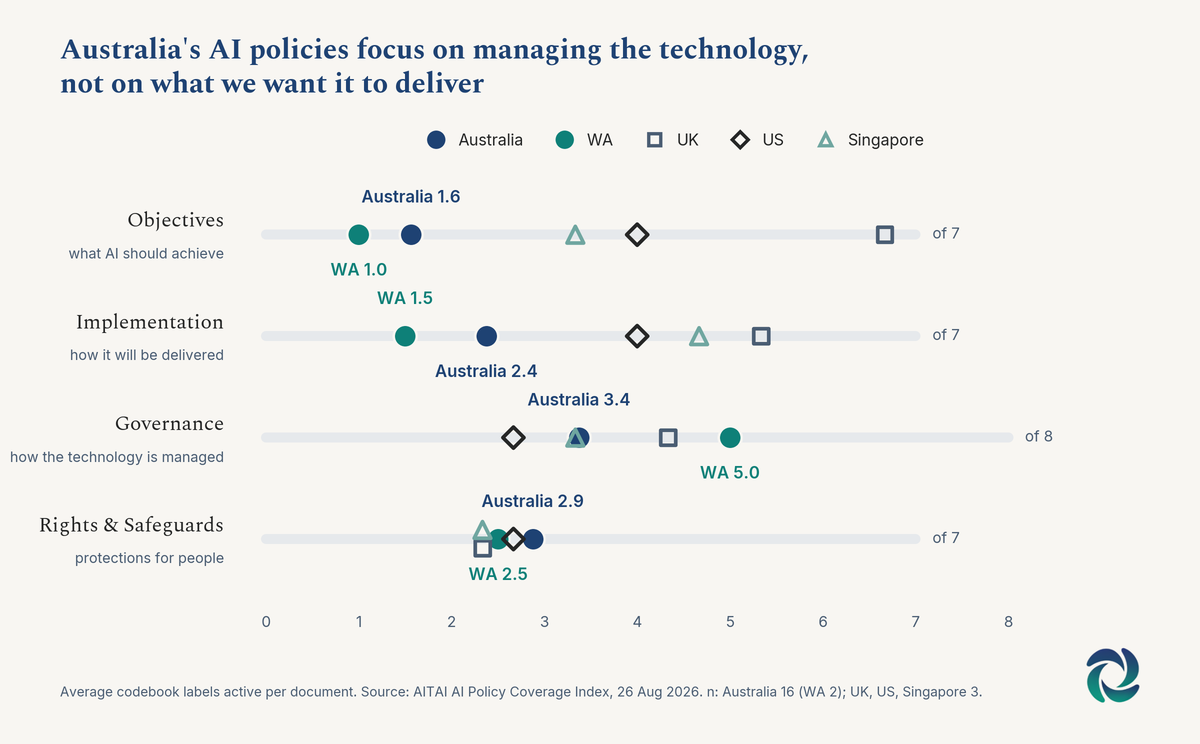
Australia's AI policies focus on managing the technology, not on what we want it to deliver.
To understand how Australia’s approach to AI policy compares to peers, we analysed 25 AI policy documents: 16 Australian (federal and state) and nine from the UK, US and Singapore. We asked the same four questions of each: what does it want AI to achieve, how will it govern the technology, what protections does it offer people, and how will any of it actually be delivered.
Australia's typical AI policy document says far less about what AI should achieve, and how it will be delivered, than its international comparators. Of the seven objectives a policy might set out, an Australian document addresses 1.6 on average and a UK document 6.7; Singapore's address 3.3. On delivery it is 2.4 of seven for Australia against 5.3 for the UK and 4.7 for Singapore. Taken together, Australia's 16 documents cover almost everything we looked for, but that breadth comes from volume: most are instruments governing government's own use of AI. The UK's three documents cover more ground on what AI is for and how it will be delivered than Australia's sixteen.
This is starker in WA: Western Australia has not yet set out how it wants AI to benefit the state. WA's two documents, the WA Government AI Policy and the WA Health AI Policy, specify how agencies should govern AI use in more detail than most other states (5.0 of eight governance provisions per document against 4.2). On everything else they say less. On what AI should achieve, WA's only stated objective is public-sector use, with nothing on innovation, skills, adoption, inclusion or data infrastructure. On delivery, there are no funding commitments, timelines or delivery partnerships. Other states cover all of these. On protections, WA does not address vulnerable groups or workers, both of which NSW does.
Fine print. Coding as at 26 August 2026. Coverage measures breadth, not the quality or adequacy of what a document says. A label counts only where a document explicitly and substantively addresses it, backed by a quoted passage; borderline cases are coded as absent, so the figures err toward under-counting. Counted by union (any label active anywhere in a jurisdiction's corpus) Australia leads every comparator; per-document averages are used here because Australia's corpus is 16 documents against three per comparator. The per-document figure reflects the mix of documents, not the absence of national direction: Australia's two national strategy documents, the 2021 AI Action Plan and the December 2025 National AI Plan, each activate six of seven Objectives labels, in line with comparator strategy documents, but they sit alongside 14 instruments most of which concern government's own use of AI. The codebook is AITAI's, built on an initial document pool from the OECD.AI Policy Observatory and extended with Australian state documents the Observatory does not hold. Comparator documents were assembled as a reference set rather than sampled systematically, and with three per country a single strong document moves the average. WA's figures rest on two documents. We have since identified two additional WA documents to code next: WA Government AI Frequently Asked Questions (Office of Digital Government) and Privacy and Accountability in Automated Decision-Making (Office of the Information Commissioner WA).