Australia’s Productivity Challenge and the Strategic Role of AI
Published February 2026
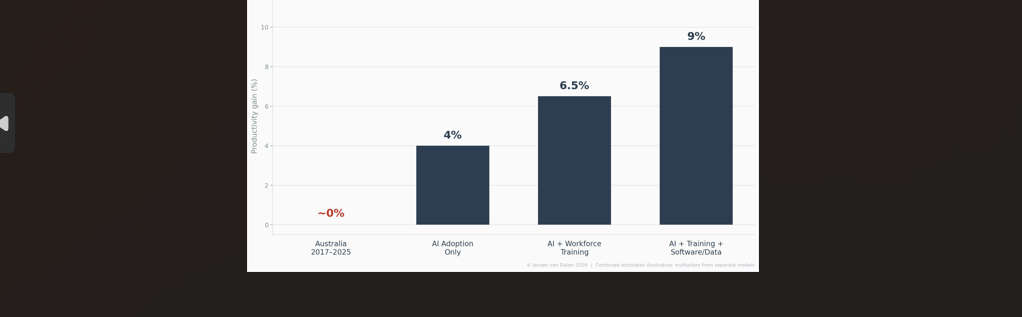
Over the past eight years, growth in Australia’s labor productivity has been minimal, with Australian Bureau of Statistics data showing that multifactor productivity has declined for five consecutive years and is now back around pre-pandemic levels. From 2017 to 2025, aggregate productivity growth has been close to zero. For an advanced economy, a period of this length suggests a structural constraint rather than a short-term cyclical slowdown.
At the same time, emerging international evidence suggests that artificial intelligence may already be delivering measurable productivity gains at the firm level.
A recent study by the Bank for International Settlements and the European Investment Ban, BIS Working Paper No. 1325 (Aldasoro et al., 2026), analyzed data from more than 12,000 European firms to isolate the causal impact of AI adoption on productivity. Because of its large sample and careful research design, the study provides strong evidence about the economic impact of AI adoption.
The findings are significant. Firms that adopted AI experienced, on average, a productivity increase of approximately 4 percent. While 4 percent may not seem dramatic on its own, in the context of nearly a decade of weak or near-zero productivity growth at the national level, it represents a substantial economic gain.
More importantly, the study shows that AI’s impact depends on how it is implemented. Productivity gains are much higher when AI adoption is combined with other investments. Firms that paired AI with structured workforce training saw productivity rise to around 6.5 percent. When they also invested in software and data infrastructure, the gains increased further, approaching 9 percent.
The role of training is especially important. AI tools on their own can improve productivity, but the biggest gains happen when organisations change how their teams work, build internal skills, and upgrade their data systems. Simply introducing new technology is not enough. When AI is combined with training and the right infrastructure, the results are much stronger.
Equally important, the paper finds no evidence of systematic job losses linked to AI adoption in the firms studied. On the contrary, wages increased in organizations that paired AI with training and complementary investment. This suggests that, at least in the observed sample, AI functions primarily as an augmentation technology rather than a displacement mechanism when implemented alongside workforce development.
Historically, general-purpose technologies such as electricity or information technology required long diffusion periods before aggregate productivity gains became visible. The BIS evidence indicates that AI may be producing measurable firm-level effects earlier in its adoption cycle than many expected. That does not guarantee immediate national productivity transformation, but it does suggest that the opportunity is already tangible.
For Australia, and particularly for Western Australia, this raises a clear question. If productivity has been weak because of deeper structural problems, then small adjustments will not be enough to fix it. The evidence suggests that using AI more broadly, while also investing in skills and better data systems, could help improve economic performance in a meaningful way.
This is where institutions such as AITAI have a defined role. Advancing AI capability is not solely about technical research or model development. It requires leadership education, workforce training, industry collaboration, and translation of research into applied outcomes. Productivity gains are not automatic; they depend on how organizations integrate AI into real operational contexts.
AITAI’s focus on industry engagement, leadership capability, and ecosystem coordination reflects this reality. If AI is to contribute meaningfully to Australia’s economic resilience and long-term prosperity, the conversation must expand beyond experimentation and into measurable economic impact.
The evidence base is strengthening. The economic case is emerging. The question now is how quickly Australia chooses to align capability, policy, and industry action around it.
Reference:
Aldasoro et al. (2026), BIS Working Paper No. 1325, Bank for International Settlements.
https://www.bis.org/publ/work1325.htm