Understanding AI’s Rapid Progress
Published February 2026

Jeroen van Dalen
Founder & Director, AITAI
Founder & Director, AITAI
Founder & Director of AITAI, AI technologist, optimistic about our AI future. CEO at Integral - one of Australia's most prominent leadership development boutiques.
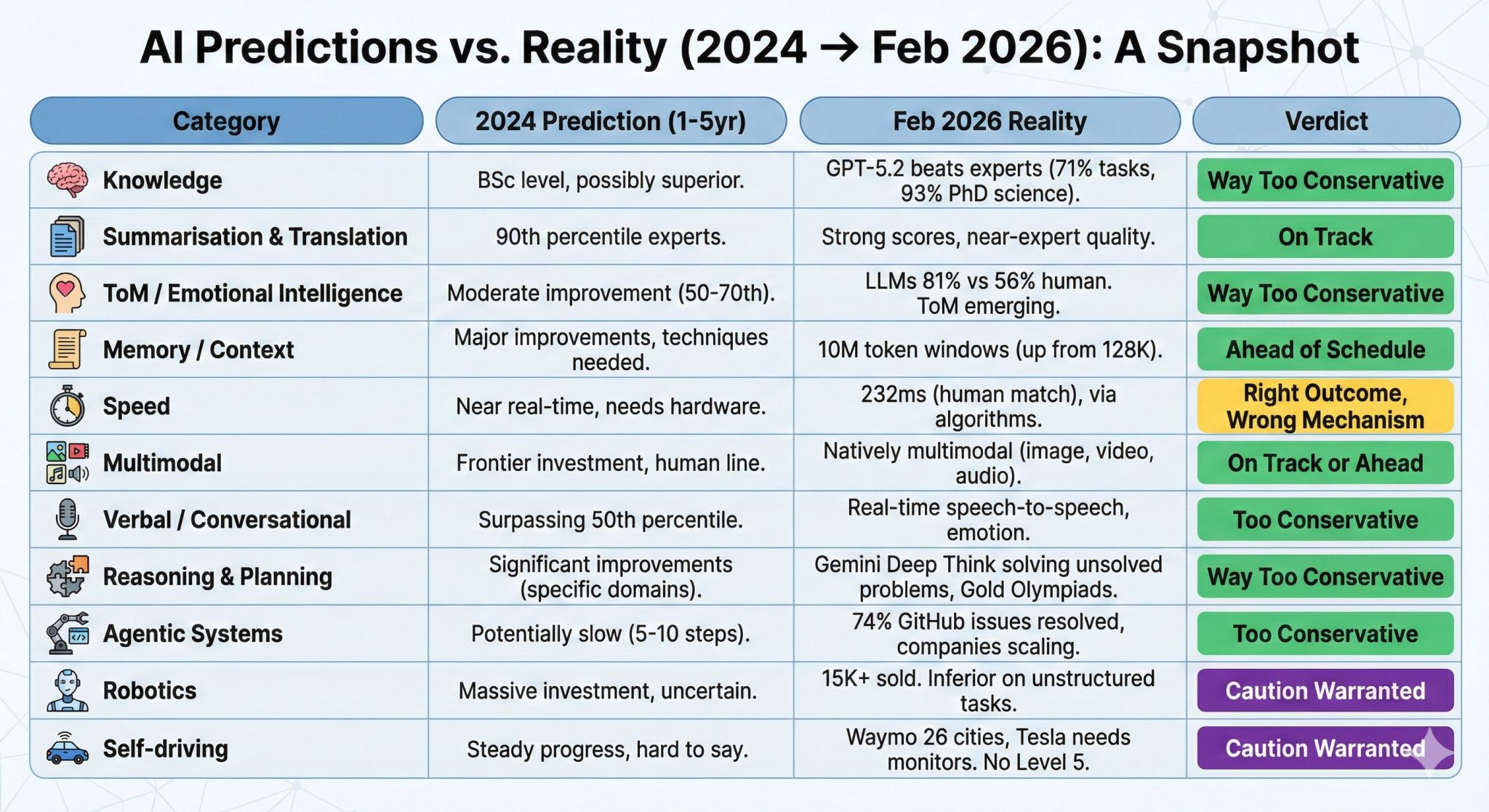
In early 2024, Jeroen van Dalen, Director of the Australian Institute for Transformation & AI (AITAI), wrote a 10-page strategy document for Integral exploring where artificial intelligence might be heading over the following five years. The analysis was optimistic and ambitious. It examined how advances in compute, data, and algorithms were likely to reshape AI systems between 2025 and 2029, forecasting major improvements in reasoning, memory, multimodal understanding, and autonomy. At the time, these projections were considered bold.
Two years later, many of those projections already feel conservative. Now, in early 2026, we are approaching the midpoint of that original forecast window. Looking back, a clear pattern emerges: the direction was largely correct, but the speed of progress was underestimated. Capabilities that were expected closer to the end of the decade are already beginning to emerge. In several domains, advancements have arrived far sooner than anticipated, in some cases at nearly twice the expected pace. Importantly, this acceleration is not limited to one area; it is evident across the entire AI stack, from underlying infrastructure to user-facing applications.
From Uncertainty to Capability: Advances in AI Reasoning
One of the clearest examples of this acceleration can be seen in reasoning and planning. In his early 2024 analysis, Jeroen noted that “large advances in algorithms are required” and that it was “currently unknown how to get to general reasoning in AI.” At the time, this assessment reflected reality. Models struggled with basic mathematics and multi-step logic, and complex reasoning was often fragile and inconsistent.
Over the past two years, this picture has changed dramatically. Frontier systems are now achieving gold-level performance in Mathematics, Physics, and Chemistry Olympiads, integrating knowledge across domains, solving unfamiliar problems, and adapting to new contexts with growing reliability. What once appeared to be a distant research frontier has rapidly become part of everyday AI capability.
This shift is further reflected in recent developments such as Google’s Gemini Deep Think model, which reportedly contributed to 18 previously unsolved scientific problems. AI systems are no longer merely supporting researchers; in some cases, they are beginning to participate directly in scientific discovery.
Memory, Multimodality, and Speed: Quiet Revolutions
Improvements in reasoning have been matched by major advances in memory, perception, and interaction. In 2024, context windows of around 128,000 tokens were considered impressive. Today, multi-million token systems are becoming increasingly common, allowing AI to work with far larger documents and longer conversations without losing context.
At the same time, multimodal capability has advanced rapidly. Models that were once primarily language-based can now reason across text, images, audio, and video, interpreting charts, analysing diagrams, and responding naturally to spoken instructions.
Speed has improved in parallel. Interactions that once felt slow and fragile are now close to real time, enabling more fluid collaboration between humans and AI systems.
The Power of Compounding
Beneath these visible advances lies a deeper structural shift. In his 2024 analysis, Jeroen argued that AI progress rests on three interconnected foundations: compute, data, and algorithms. When these elements advance together, their impact is not merely additive, it multiplies.
Over the past two years, this compounding dynamic has become increasingly evident. Investment in infrastructure has expanded significantly, enabling longer and more sophisticated training runs, while specialized accelerators have become widely deployed. At the same time, ongoing improvements in algorithmic efficiency are extracting greater performance from similar hardware.
These developments reinforce one another. More capable algorithms make better use of larger datasets, which in turn justify bigger models and attract further investment. The outcome is cumulative and accelerating, progress that increasingly follows an exponential rather than linear trajectory.
Why This Matters for Western Australia
These technological shifts have clear and lasting practical consequences. For Western Australia’s research community, industry leaders, and policymakers, the accelerating pace of AI capability development is reshaping how institutions plan, operate, and invest for the future. Skills frameworks can no longer remain static, governance models require ongoing refinement, and research practices and business strategies must adapt more rapidly than in previous technological transitions.
In this context, decisions made today will shape competitiveness, resilience, and social outcomes for years to come.
This is where AITAI’s role becomes increasingly important. By connecting researchers, industry, and public leadership around evidence-based understanding of AI, the Institute helps ensure that adoption is informed, responsible, and aligned with long-term public value. In a rapidly evolving environment, understanding not only where AI is heading, but how quickly it is moving, has become a strategic capability in its own right.
Recalibrating Optimism
Revisiting the 2024 forecasts shows that long-term thinking remains valuable. Many of the core assumptions were sound, the key drivers were correctly identified, and the most important capability domains were highlighted. What was underestimated was the strength of compounding effects.
Exponential systems consistently outpace linear intuition, and even optimistic projections struggle to keep up once reinforcing feedback loops take hold. As recent experience has shown, progress can accelerate faster than expected when multiple technological forces align.
If the past two years are any guide, the next five will require continuous reassessment, intellectual humility, and a willingness to revise assumptions as new evidence emerges. In an era of accelerating transformation, optimism remains justified. It simply requires regular recalibration.
Further Reading:
The original early-2024 analysis that informed this reflection (with organization-specific sections removed) is available here:
https://narrow-humor-68d.notion.site/AI-predictions-from-early-2024-3073177a77a880a6a78ded9b930492e7?pvs=74
© Jeroen van Dalen, 2026