
Articles & Publications
AITAI articles, reports, and policy insights on AI transformation in Australia.
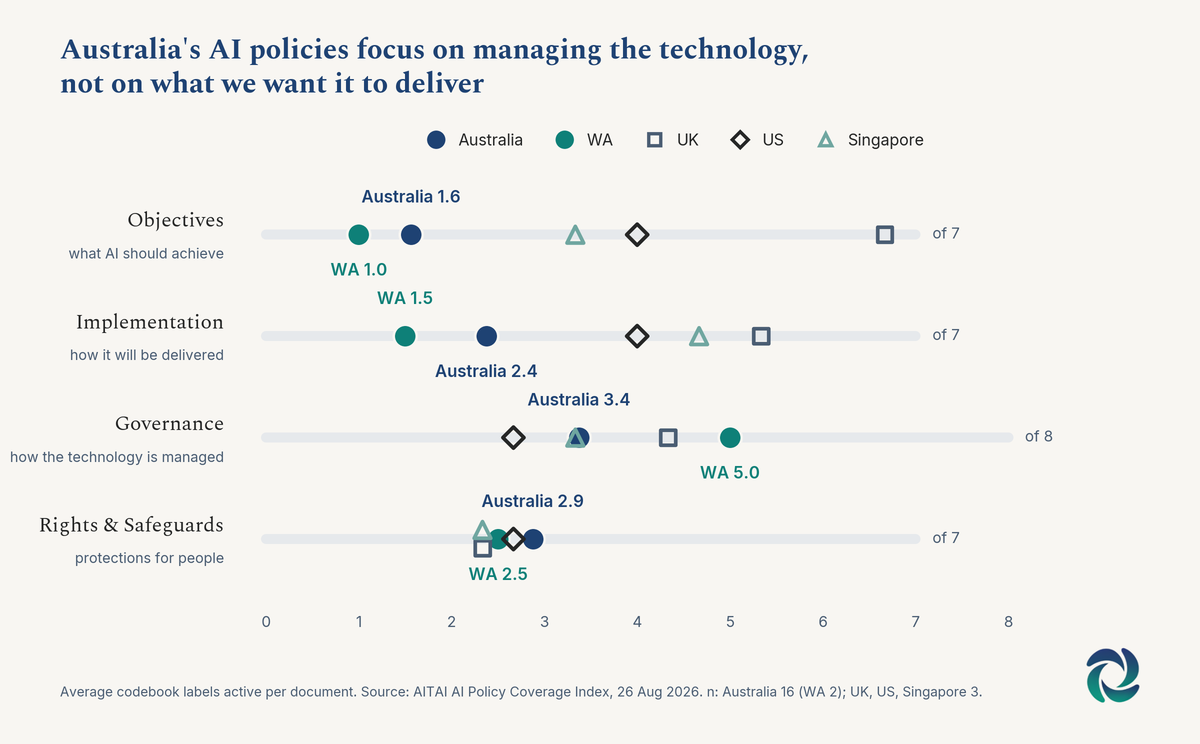
Australia's AI policies focus on managing the technology, not on what we want it to deliver.
To understand how Australia’s approach to AI policy compares to peers, we analysed 25 AI policy documents: 16 Australian (federal and state) and nine from the UK, US and Singapore. We asked the same four questions of each: what does it want AI to achieve, how will it govern the technology, what protections does it offer people, and how will any of it actually be delivered. Australia's typical AI policy document says far less about what AI should achieve, and how it will be delivered, than its international comparators. This is starker in WA: Western Australia has not yet set out how it wants AI to benefit the state.
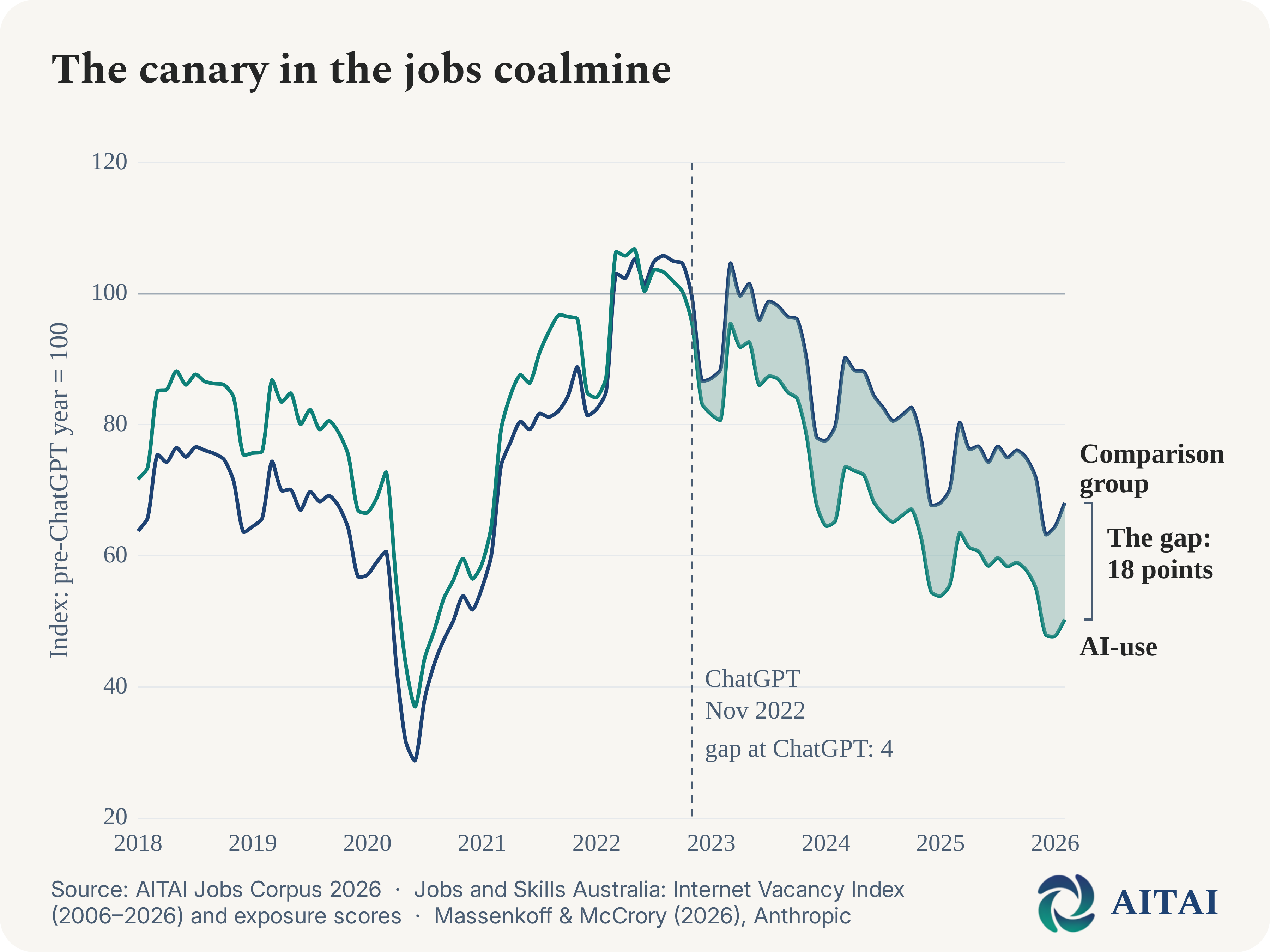
Is AI affecting Australian jobs?
Whether and how much AI will affect jobs is top of mind around the world. Will change come gradually, giving workers and institutions time to adjust? Or fast, bringing displacement and disruption? Our work found a small but significant signal: hiring in the occupations where AI is used is running about 5,500 advertisements a month below comparable occupations. That is roughly 24 missing for every 100 openings they posted in a typical month before ChatGPT, or about 2% of all job ads nationally.
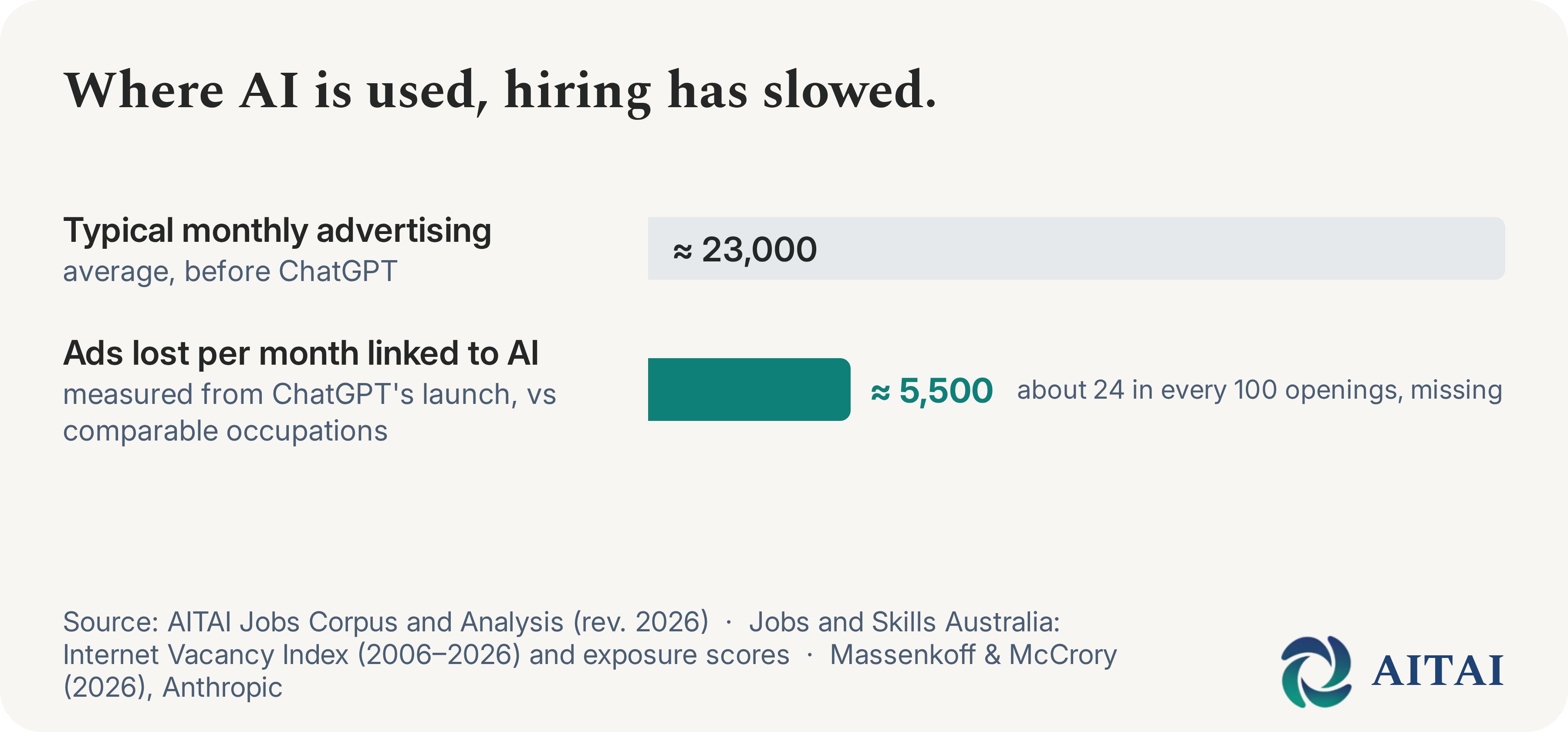
Where AI is used, hiring has slowed.
AI is starting to show up in Australia's job ads. We compared job advertisements for occupations where AI is actually being used; jobs like software programmers, analysts and call centre workers, against similar occupations where it isn't. Measured from ChatGPT's launch in November 2022, these occupations are now advertising around 5,500 fewer openings a month than their counterparts. That gap is too large to be chance.

The AI silence in Australia's NFP sector… with one exception
Among Australia's largest not-for-profits, AI has barely surfaced in official reporting. In verified FY2025 annual reports, just 5% of the largest NFPs mentioned AI at all — a tenth of the rate for ASX-listed companies, at 50%. However, major universities (also not-for-profits) sat at 92%.

When the story is jobs, the coverage turns negative.
When Australian media writes about AI and jobs specifically, the tone is far darker than when it writes about AI more broadly. In our corpus of AI coverage, articles on the topic of jobs ran 87% negative in the first quarter of 2026. This is well above the negativity of AI coverage in general.

Australia is quiet on AI - at least in annual reports
UK and US listed company annual reports mention AI far more than those of ASX listed companies.

Get Full Access to Research
Join AITAI to unlock member-only publications, policy insights, and exclusive analysis.
- Access member-only research and reports
- Early access to new publications
- Invitations to research briefings and roundtables
- Connect with AITAI researchers directly